A hidden gateway in time lies in Csopak. The ruins of St Nicholas Church are not just medieval blocks of stone, but a living museum reaching from Csopak's deepest historical layers back to the Bronze Age. Discover with us what these walls tell about the Christian past of the area, the storms of the Ottoman occupation, and how a church became a swineherd's stable!

The birth of the church: the spiritual centre of Kövesd
The church that stood where the ruins are today was originally consecrated in honour of St Nicholas the bishop in the 13th century. It was first mentioned in writing in 1363, when it served as the centre of spiritual life for the village of Kövesd (now part of Csopak). Features of the late Romanesque building:
- Single-nave floor plan with east-west orientation
- Straight-ended sanctuary on the east side
- Entrance with a red sandstone frame on the south side
The church was not only a place of prayer but also a venue for community life. Surprisingly, however, no medieval graves were found during the excavations.

Ottomans, nobles, swineherds: the drifting fate of the ruins
The church's fate took a fatal turn in the 16th century, when it was abandoned during the Ottoman occupation. Maps from 1783 already refer to it as an "old, ruined church" (Eine alte schon zerfallene Kirche). In 1796 the local nobles tried to reclaim the building from the chaplain of Veszprém in order to turn it into a Calvinist church, but their request was refused.
In the early 1800s the ruins were bought by the Noble Land Community of Kövesd. During its alterations:
- A thatched roof was built
- The sanctuary became a stable
- The nave was turned into a shepherds' barn
- A bull pen and a swineherd's house were built next to it

An archaeological wonder: when the earth gives up the past
During the excavations of 1964-66, the farm buildings added later were demolished, revealing the church's original form. The astonishing discovery:
- No medieval graves
- Copper Age finds: pottery fragments from 4500-3500 BC
- Late Bronze Age remains: tools from 1300-800 BC
These finds show that the hill was already in use in prehistoric times.
Architectural secrets: what might it have looked like originally?
Based on Flóris Rómer's description from 1861, the church's original appearance can be reconstructed:
- Nave: 18 metres long, 7 metres wide
- Sacrament niche: remains of a niche built into the north wall
- Cornices: surviving decorative elements on the west facade
The red sandstone frame of the south entrance can still be seen today.

Practical information for visitors
- Nearby sights:
- Csákány-hegy Lookout
- St Stephen's Church

Pro tips for the perfect visit
- Visit at dusk: the golden light of the sunset lights up the stones beautifully
- Go with a guide: a local history guide can tell you much more about the ruins
Summary: where the centuries meet
St Nicholas Church ruin is not just a pile of stones. It is a sacred place where the footprints of Bronze Age ancestors, medieval believers and modern-day tourists mingle.
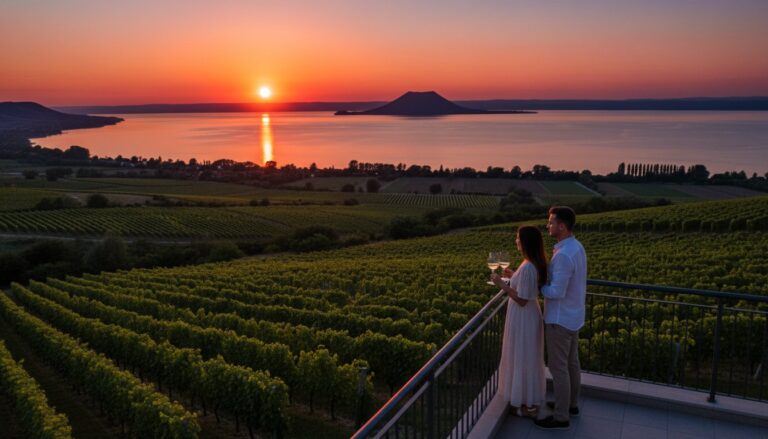
Whether it's quiet meditation in the morning mist or exciting historical research, this place enchants everyone. And don't forget: the ruin is within walking distance of Hotel Csopak, and with a glass of local wine in your hand, the journey through time is even more enjoyable!
Earlier posts:
Springs and wells of Csopak: the magic of water in the heart of the Balaton Uplands
MotoGP 2025: an exciting season and the return of the Hungarian Grand Prix
The perfect corporate event venue at Hotel Csopak Resort & Lake